Styrene

Styrene

Wednesday, March 29, 2017

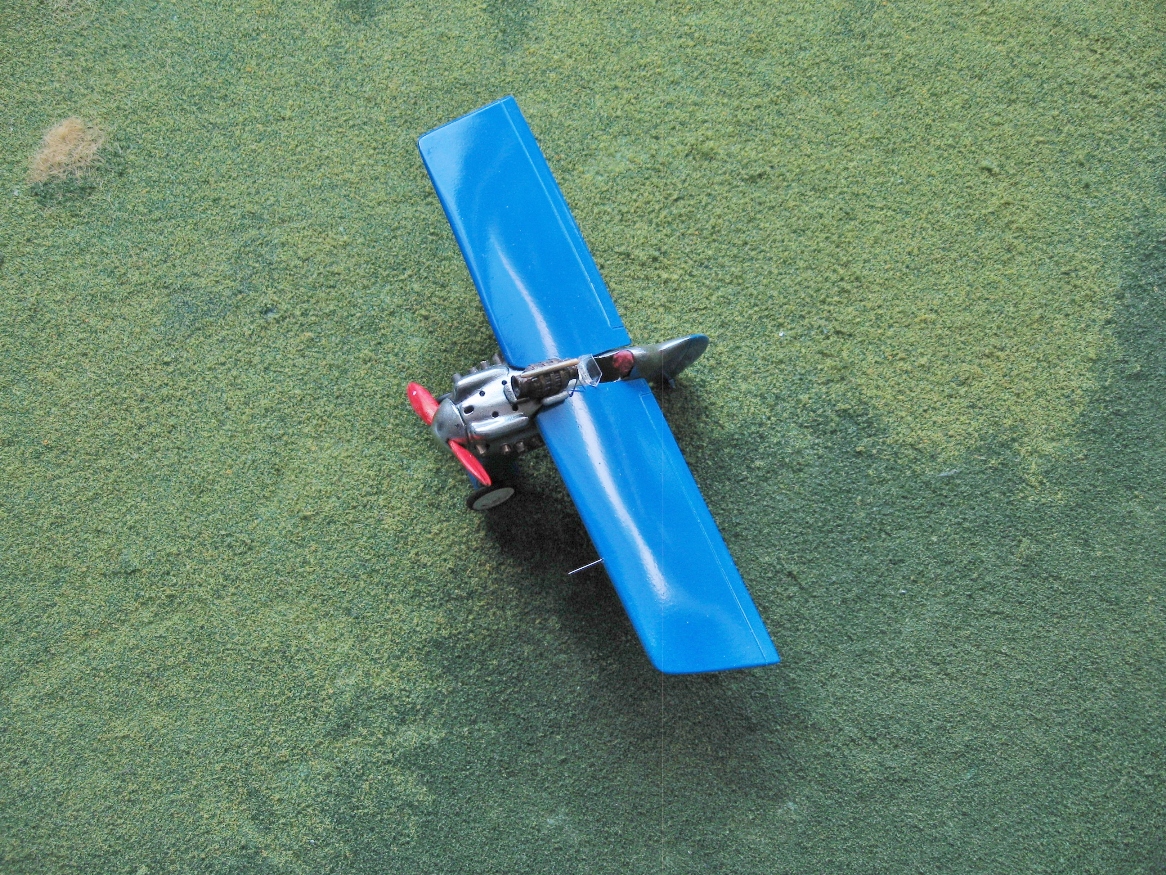
Farman 1020 (From the archives, 2007)

(Model built and article written in 2007)
 
In 1933 took to the air an experimental plane that reputedly contributed to raise French fashion design to even higher standards.
The apocryphal story goes that instead of aeronautic engineers the Farman company hired French fashion designers. After much discussion and sounds of busy scissors, the patterns for a plane emerged.
The plane made use of an adapted Farman series 400 fuselage to which a semi-circular wing of large area was attached. One can only image the discussion between the control surfaces about which will have top control what. Nevertheless the plane flew, and flew well, in-spite of the pilot reputedly having to deal with an abundance of levers protruding from every conceivable corner of the cockpit.
The model:
This is a rather simple rendition. You have the in-process images to get the idea, so I won’t have to bore you with meticulous and useless descriptions. Besides using the normal modeling paraphernalia, this time I chopped a few cylinders from an Engine & Things product to complete the engine.
Prop is carved from a popsicle wood stick and the boss is a photo-etched part.
For those of us with a bias toward the unusual, this is one that ranks high in the list; simple enough to avoid much head-scratching and good looking enough to spark the construction flame.
Haute -flying- couture!


Peyret-Mauboussin PMH X (from the archives, 2010)

(Model built and article written in 2010)
 
Looking apparently for a niche in the market for economical and affordable single-seaters, Mr. Pierre Maubossin designed a plane that was built by Louis Peyret (of Peyret Tandem fame)
The Peyret-Mauboussin PM.X all-wood, ABC Scorpion-powered cute machine was ready in 1929 and had a wingspan of 10 meters. A floatplane version, the PMH.X bis (H for Hydro) was later developed.
A two-seat, beefed-up, slightly bigger machine -the Peyret-Mauboussin PM XI- made a remarkable flight from Paris to Madagascar!
The cantilever long aspect ratio flying surfaces and the short tail moment made the plane look definitely elegant, with slightly awkward although charming proportions.
The main components were basically built over a rainy weekend, quite small in 1/72 and simple enough to make the building process run smooth.
Photos as customary intend to depict the methods and materials used. And don’t worry, I’ll working on a scaled pond so I don’t have to put the hydroplanes on the grass anymore.
The all-wood construction of the original and the absence of markings (using as reference one photo that so portrayed the plane) accounted for a relatively easy finishing. For that wood finish color information I am in debt with master scratchbuilder and famous Canadian Cycling Gremlin Alain Bourret.
Mr. Mauboussin went one to produce a notable family of designs, but that’s another story.
Au revoir, mes amis!


Arnoux Simplex Racer (from the archives, 2008)

(Model built and article written in 2008)
First a few words regarding this article:
The objective of this series was to spark awareness and interest regarding wonderful but lesser known designs, especially from the Pioneer and Golden Era periods of aviation. Their creativity, significance, and unparalleled charm are for me (and perhaps for many of you) a very important but often overlooked part of aviation history.
I would also like to express my thanks to the ones that with their supportive, affectionate, informative and sometimes witty correspondence established a wonderful feedback that allowed me to improve my articles and models. Thanks also for the invaluable help received from fellow modelers, aviation enthusiasts and friends.

Was Mr. Arnoux a minimalist? Were his creations early expressions of Minimal Art?
The concept of Minimalism, applied now to creations in diverse media that characterize for being stripped to their essential components or elements, both structurally and expression-wise, surely can be applied to Arnoux’s aeronautic creations. His work in the field was precursory in many ways, and the rationale behind his research can perhaps be summarized as: -Which are the essential components of a plane?: a lifting surface, a power plant, and the space necessary for the pilot.
I have previously dealt with one of Arnoux’s earlier creations, the Stablavion of 1912
And this is the fully evolved concept, of 1922. Built to compete in the Coupe Deutsch, a control problem and the subsequent rough landing prevented this incredible design to enter the event. It was powered by a Hispano-Suiza engine and the control surfaces at the wing’s trailing edge acted as what we would now call elevons. Vision for the pilot was masterfully impaired by having his head protruding on top of the trailing edge and behind the cumbersome Lamblin “lobster-pot” radiator.
As usual with these odd-balls, references are not abundant. Fellow modeler and friend Jim of the Puget Sound helped a lot with this one. The plans that are around are good, but as usual the few available photos quickly showed some minor inaccuracies, mainly in the landing gear, lower tail and a few details in the radiator area.
Once the model engineering was solved (at least in paper) it was out with the Mattel to vac the fuselage sides and just a bit of careful work on the Lamblin radiator and the wood prop. The remaining parts, including some interior and exterior details, were straightforward although the fuselage nose took some fiddling because of the number of details grouped there.
No decals for this one, which alleviates the task, and just some airbrushing for the two-tone livery that was the product of educated guessing.
Minute, cute, plumped-looking “tailless” racer to celebrate aviation history!